‘JAAC is very much a people’s movement and should be treated like that by the Pakistani state.’ – Understanding Azad Kashmir’s Long March
- June 24, 2026
- Posted by: admin
- Category: News
‘JAAC is very much a people’s movement and should be treated like that by the Pakistani state.’ – Understanding Azad Kashmir’s Long March
(This interview is of Shams Rahman, taken on 11th June, 2026 by Osaid from South Asia Solidarity Group, based in London. The situation in Kashmir is ever-changing, and therefore, we urge you to follow appropriate sources to keep updated, such as @kashmirissues, @photographybysufian, and @haa.puth on Instagram .)
Shams Rahman is a prominent writer from Kashmir. In this interview, he explains the current political environment in Pakistani-administered Azad Jammu and Kashmir, highlighting atrocities carried out by the state against the people’s movement led by the Jammu Kashmir Joint Awami Action Committee (JAAC). He describes the origins of the movement, the main demands laid out by it, and how it has managed to create a support base amongst the local people in Kashmir ahead of pivotal elections scheduled on 27th July.
Osaid: A good place to start is your article that you published recently. Since then, JAAC has been banned, there have been communication restrictions and internet blackouts. So in light of your article, how do you see what is happening now?
Shams: It was expected that the state would use force to stop the Long March. Because, when the first Long March was held in May 2024, they did the same thing. One person was killed in my home town, many were injured and three people were killed in the capital. There was a communication blockade during the second Long March, on 29th September, 2025, after which, the state media started alleging that JAAC has links with India, implying that it is a security issue, essentially to justify the state’s repression. However, with the huge number of people who came out, it was perhaps not possible to kill as many people as the state thought they could. That is why the narrative suddenly changed. The Prime Minister of Pakistan said the Kashmiris are our own people and we want to solve the problems.
There were negotiations and 38 points were agreed. One of the issues and demands has been the abolition of 12 seats in the Azad Kashmir assembly. These seats are meant for Kashmiri refugees settled in Pakistan. These are people who do not live in Azad Kashmir and as such they are not local people concerned about Azad Kashmir issues . The other issues are to do with economic improvement and better public services like health and education, as well as implementation of some court rulings on Azad Kashmir’s resources, like the electricity from the Mangala Dam which was to have been free in Azad Kashir, but never was, and the electricity from the Neelum and Jhelum rivers. All these points were agreed upon. After that, there were no clashes and state forces were withdrawn. Talks continued between the monitoring committee and the legal committee. There were some issues on which the action committee objected. One of them was the agreement that the 12 seats for refugees will be discussed according to their legal status and how that can be changed. It was agreed that until the next election, or until the decision is made to abolish them, the seat holders will be considered normal assembly members. However, it was also agreed that these members should have their privileges revoked, i.e., the ministries and other positions should be taken away. However, in contradiction to this, these members were then made chairmen of public account committees amongst other positions.
There were steps taken initially to implement other points but were stopped halfway and excuses were made. JAAC objected and set up an implementation tracker. When negotiations broke down, JAAC claimed that only a few points had been implemented. Then this issue of representation of refugees became a contested issue because the state claimed that it is a Constitutional issue, and changes can only be made through a Constitutional Amendment. This sounds reasonable, but if you look at the way Azad Kashmir is governed, it is not. When the prime minister was elected within the assembly, almost all members voted for him from all parties. So people could see that the Constitution and courts are used only to help the rulers. JAAC then argued that if the state wanted to make the change it could do so overnight and the only way to communicate with the state is through protest.
So in February, JAAC announced that if the agreement is not reached, then on the 9th of June, 2026, there will be a general strike and a Long March towards Muzzaffarabad. They said they would sit there indefinitely till the local assembly is made properly autonomous. At this point, the negotiation was still going on, but the government was not being serious. They were trying to convince people to stay away from JAAC. Politicians started saying that they have implemented every point, except the one on the 12 seats, implying that JAAC are causing chaos. JAAC started doing awareness conferences and titled them as the Right to Ownership and the Right to Governance. They pointed to the hospitals and the schools, showing that nothing on the ground had changed. People were consulted and the decision was made to go for another protest. JAAC told state representatives that it had no choice but to move forward with the third Long March.
The state called in 14,000 military personnel, proscribed the JAAC as a terrorist organisation, and announced bounties on its leader’s heads. In Rawalakot, which is the epicenter of this struggle, the state forces besieged gathered protestors. According to local accounts, the forces stopped members of JAAC and started beating them up, eventually firing shots. A key leader, Umar Nazir was shot twice, but ultimately, saved by his colleague, Zohaib, who took a bullet on his chest, and unfortunately, passed away. There was violence when Zohaib’s body was taken to Rawalakot Hospital. The police sources blamed the protesters but local people have said that they were shot at. Three local policemen were killed along with four civilians. In total, so far, local people have said that 13 people have been killed in different clashes, including three policemen and one Pakistan Ranger. People have claimed that local policemen were killed by the Rangers because they refused to open fire on protesters. Eventually, Rangers took control of hospitals, arrested all the injured, those volunteering rescue services, and those giving blood.
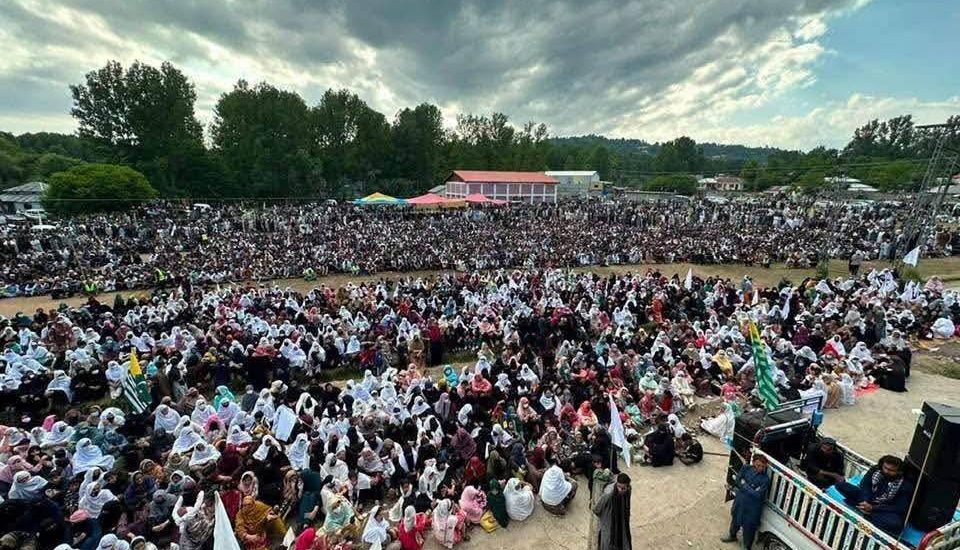
At the same time, marches were started from different regions on the morning of 9th June. The turnout was big despite severe repression. There are several gatherings of thousands of people at different places. Last night, Umar Nazir shared that he was approached by the state for negotiation, and he has given them preconditions, which includes stopping attacks on marchers immediately, taking forces out, de-proscribing JAAC, removing the bounties on its leaders’ heads, giving dead bodies to families, and leaving hospitals. I have not seen anything from the state’s side yet. But there are reports that one person was killed last night, and about four or five were injured in the early hours of today.

Meanwhile, helicopters were used to monitor where people were going. One crashed in Muzzaffarabad. About 25 force personnel died. I saw the video of that crash, and if you hear the reaction of the people, you will see that people in Azad Kashmir are not against Pakistan or against its army. Of course, there are political activists who criticize Pakistan, and those who want an independent Kashmir. But JAAC, from day one, made it very clear that this is not for the independence of Kashmir. This is for internal autonomy and local rights, so people can make government institutions accountable. That is also why initially JAAC was attacked by the local government leaders, while they were too busy trying to liberate the Indian side of Kashmir.
But obviously when that issue was forcefully crushed by India, and Pakistan did not do enough to challenge it, people started thinking that unification and independence of Kashmir is far too distant a reality. Therefore, they should focus on where they live, where rulers abuse power due to no fear of accountability. The generation which grew up watching these governance failures are now challenging them. The state should see that local rulers in Azad Kashmir are using them to crush a genuine people’s rights movement, which is not against Pakistan, unless the state has an agenda to follow in India’s footsteps. So, if we think about the international context, that could be the situation. But obviously, interpretations depend on who is in power and how determined they are to crush JAAC. At the same time it is very difficult to silence people’s genuine demands. We are hoping that sanity will prevail. It’s always the duty and responsibility of governments to avoid violence, and to listen to people. If people do a peaceful protest, that is their right. JAAC’s demands are not unreasonable because they are not going beyond the limits of the Constitution. So, proscribing JAAC as a terrorist organization is wrong, and with JAAC’s large support base, I don’t know where it will lead to.
Osaid: Yeah, it’s hard to tell at this point. I did have some questions about the background of the movement, because it began as a material grievance on electricity prices and floor subsidies but has developed into a broader movement. So I am curious about how that transformation happened.
Shams: It started with a dispute with the flour supplying depot in Rawalakot. I met Umar Nazir, who started all this and runs a bakery in Rawalakot. The flour prices were increased by the government, and the supplier was selling the flour he already had in his store at new prices, and some of the traders said that this is not fair. So they started protesting outside of that depot. At first, there were maybe 10-12 people at the protest, and 20-30 when they did a march. Gradually, people started joining. The demands actually increased to include supplying electricity at production cost and the abolishment of the elites’ privileges. By the end of July 2023, JAAC’s first consultation meeting took place in Kotli, which was attended by some senior nationalist leaders. I went with the Mirpur delegation. In that meeting, they decided to boycott the electricity bills because there were so many irrelevant taxes on those bills, and the per unit cost was averaging 35-40 rupees. By September 2023, every sub-district was represented.
Then JAAC elected 31 representatives from each sub-district to form the JAAC. There is no one leader and they go to the local committees to consult people and hold discussions. The discussions are very open and blunt, and all decisions are made collectively. That is why they have survived difficult phases. The committee is not made up of one ideology. It includes nationalists, progressives, pro-Pakistan ascensionists, etc. Their focus is not any ideology or political party, and they call themselves non-political, which they had to, because here, politics is considered a bad word, implying corruption and power abuse.
Initially, I couldn’t understand why this became a popular movement because resistance politics has existed from the 1950s, and there were so many organisations: extreme left and some extreme right. But they had no connection with the people, only serving as discussion forums for youngsters. I met people who, usually, run from any kind of politics, but they said that they boycotted because they simply couldn’t afford it and this was the first collective action they could all do.
Osaid: My follow-up question on that would be how did the demand for the 12 refugee seats get included.
Shams: After the first Long March, out of the three demands, two were acted upon. Electricity and flour prices came down. The third demand, abolishing privileges for the elite class, was accepted in principle, but nothing practically was done to implement it. The government said that the elites have no privileges, and if they do, they are the same as any mainstream Pakistani politician. They asked JAAC which privileges should be abolished, and were given a list, which they ignored. Meanwhile, more issues were raised by people. Demands were increased to eight. An agreement with the Azad Kashmir government was concluded but nothing happened. Then the government stopped replying to reminder letters sent by JAAC, who then held a conference, before which it had informed the government that if the demands were not implemented, more demands would be added. The government did not take that seriously and the demands were increased to 38, which included this abolition of seats.
In my personal view, this demand is not very wise. I know that those seats are abused by the Pakistani establishment to make or break the government and to twist the arms of the Azad Kashmir government. I agree that the Azad Kashmir government has nothing to do with issues beyond its geographical boundaries, and the people in those seats live in Pakistan, where they are full citizens, so they shouldn’t be able to make decisions about issues affecting people here. But I wrote that because these people are Kashmiri, there is a clear political link between them and the Kashmir issue. So, politically, it is not wise to make this demand. It’s okay to make demands to make changes to the way they get elected, registration of their votes, and the proportion of their number in Pakistan to the seats. You can ask to make them symbolic rather than voting members, and say they should not be able to vote on the issues affecting people here. But corruption is not confined to just those 12 people. All other members are corrupt as well.
But JAAC kept their position. Although, before the breakdown of negotiations, JAAC did offer that these seats either should be made symbolic or they should be reduced to 3-4, and they should be nominated by the parties in assembly, according to their portion of their votes, and made a member of the Kashmir Council, which is a symbolic body that links Pakistan and Kashmir. But obviously, that was not acceptable to the state, whose position was that this is a constitutional issue. JAAC then gave the government three months, after which another Long March would be the only option left.
Osaid: Why did they choose this strategy of the Long March, especially if there were other strategies?
Shams: I was not of the view that there should be a Long March. Because people were not paying their electricity bills – in some districts, 90% didn’t pay. The lowest in any region was 50%-55%. The Azad Kashmiri government was feeling the heat, and eventually, they would have agreed to the demands, and spoken with the Pakistan government, where final decisions are made. But obviously, the march was announced by JAAC after consulting local people and reaching a general consensus that there should be some kind of additional pressure on the government. This additional pressure was initially just doing a lockdown. But some activists insisted on mobilising people through the Long March. Moreover, even though, initially, the leadership was in favour of strikes and gatherings but not the march, the people themselves started it spontaneously when forces started making arrests on 9th May, two days before the march. So, in a way, it was the result of state actions as well.
Osaid: How did the demand for the right of ownership and right to govern come about as well?
Shams: The movement grew into a significant political force after winning the initial demands through the long march, which was unexpected. Therefore, it is important to understand the speed with which things change in Azad Kashmir. My own background is that I was initially involved in independence politics from 1948. But gradually, my understanding evolved, and I thought that independence was maybe just a dream. So when I went back in September 2022, I wanted to understand what people were thinking and what the realities were. I met ordinary people, and they were very disappointed with no hope. They were talking about the situation in Pakistan all the time. I asked them why they were focusing on that instead of where we live. They said that any change can only come through Pakistan itself.
That was the general kind of perception. The nationalists and progressives used to protest about load shedding and inflation. But the slogans they raised were abstract and anti-Pakistan. The people started objecting to that too and rethought their way of doing politics. In fact, those closer to traditional politics are against JAAC. They were happy when state forces came. This traditional politics is rooted in clan politics and tribalism. So, until the electricity bill boycott, the general public was not really hopeful. However, with the boycott, the whole mindset changed. People realised things can happen without the Pakistani state. So, JAAC also represents a struggle against the old traditional political structure. But the state is defending that structure instead of discussing how things can be made better. The state doesn’t know how to deal with it apart from the tried and tested method of repression. It is easy to label JAAC or any other progressive organisations as terrorists because that word is more acceptable in the offices of Western powers.
Osaid: You have mentioned how the movement is run by local people. So, relatedly, where are the women? Are they involved in JAAC? Secondly, could you elaborate on JAAC’s organisational structure?
Shams: It has evolved without any blueprint and through local conditions. Local committees were formed without any formal leaders coming in and forming hierarchies. Even in the smallest village, the spaces to discuss and debate are very open. That’s why ordinary people don’t see it as an organisation of a particular leader. Obviously, some leaders have emerged as more vocal, but no one person can make decisions, which are taken collectively by JAAC. Today, the women have started their marches. Previously, they had been helping with cooking, etc, but now, a lot of them have organised their own marches. Thus, JAAC is very much a people’s movement and should be treated like that by the Pakistani state.
Osaid: Elections scheduled for next month. In that context, what do you think?
Shams: Elections are scheduled for 27th July. The authorities thought that not many people would come out for JAAC and if they did, they’d be repressed. The authorities thought that the people would eventually go back to mainstream parties. That was also why the false narrative was created that Indian currency and identity cards were found in their offices. AI content was made. The government brought out fake news that India had asked JAAC to raise the issues of flour and electricity to cause trouble for Pakistan. However, within hours, people started saying that it is fake, pointing to mistakes and contradictions in the narrative. To put it in context, this was just a few months after the India-Pakistan war, so anti-India sentiment was high. By the time the major speakers came, most of the chairs were empty. It was a total collapse of the mainstream narrative.
Corporate and state media said that the strike had failed and accused JAAC of being armed insurgents who fired at a peace march by the Muslim Conference Party. But when the media ban was lifted, we found out that it was them who started firing. The state media even instructed journalists, urging them to call JAAC a terrorist, anti-Pakistan, pro-India organisation. None of it worked. That scares me as well, because when those in power are confronted by the masses even after continued repression, it can sometimes lead the state to completely eliminate them. I hope that there is no such thinking in the Pakistan establishment. Because that can open up unexpected avenues. Especially in regards to the India-Pakistan tensions, because both abuse each other’s resistance politics. The Pakistani government has an opportunity to negotiate and understand that this movement is wider and will keep getting bigger.
Osaid: What do you think of the responsibilities the diaspora has now? Finally, if the movement succeeds, what does that look like?
Shams: The diaspora should raise awareness about JAAC, why it is important and why it should be supported. Our role is to link it with other movements. British South Asians should come together to support such movements and speak sense to the people trying to crush it. If JAAC is successful, the Azad Kashmir administration will improve. JAAC’s leadership will learn from their mistakes. The first priority is that no more lives are lost. Negotiations should start. Gradually, this network of silencing civil voices should be undone. Even now, I have felt that with JAAC’s pressure, the government officials behave slightly differently. They’re not as arrogant and indifferent and feel some sense of accountability. If JAAC is successful, that will grow.
Osaid: Thank you for taking the time out. Is there anything final that you would like to add?
Shams: One aspect which I missed in this movement is that some of the progressives played a very motivational role in this. Particularly, the youngsters who do the Halla Bol kind of politics. They improvised the famous Halla Bol song, adapting it to the present situation, and sang it everywhere. It has become a motivational song now because they incorporate local conditions in the lyrics. So, the movement has been kept culturally tied and vibrant through this music as well as poetry by other artists.